
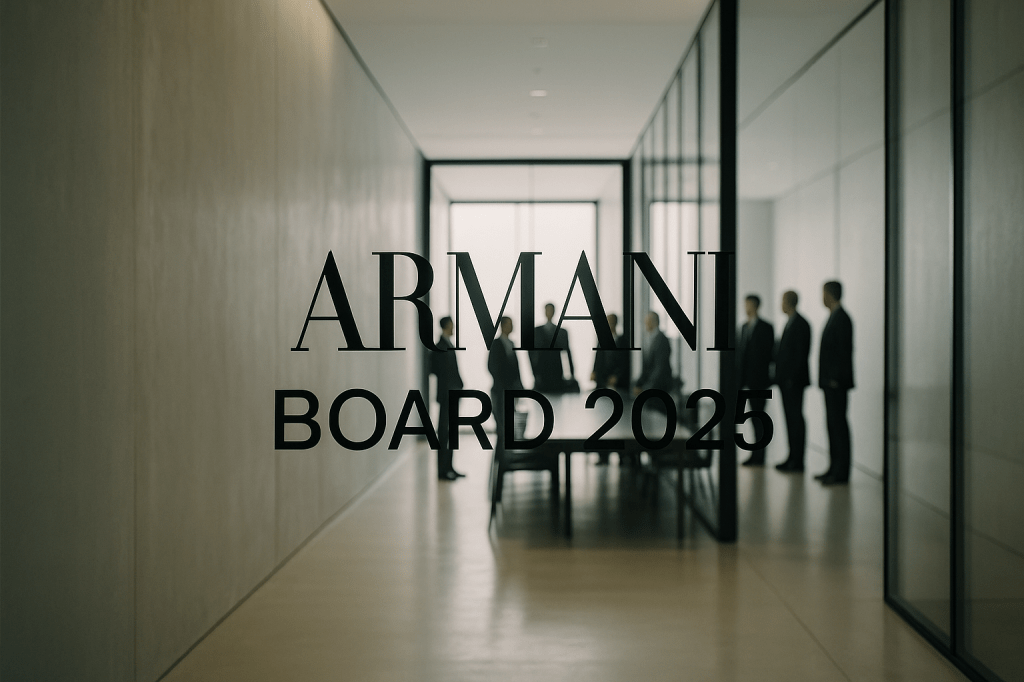
Armani’s genius endured to his final day.
The succession at Armani has not been an improvised move, nor a race against time. On the contrary, it confirms how Giorgio Armani remained fully lucid—until his last breath—not only about the destiny of his brand, but also about the structure needed to secure its continuity, credibility, and long-term strength.
The appointment of the new Board of Directors, outlined by the Foundation with a precision rarely seen in family-run luxury groups, is the ultimate proof of a project designed with method, vision, and almost surgical clarity.
The new board consists of eight members, a carefully calibrated blend of heirs, long-standing internal figures, and three external leaders who embody three essential pillars of contemporary fashion: Marco Bizzarri, Federico Marchetti, and John Hooks.
These choices were not made for symbolism—they were made for strategy.
Marco Bizzarri brings the managerial daring of one of the most brilliant phases in Italian fashion, when Gucci reinvented its visual language under the creative leadership of a young Alessandro Michele—an intuition that was uniquely his. That partnership defined an era. His presence on Armani’s board is not a tribute, but a message: the future requires a leader capable of uniting executive discipline with aesthetic courage.
Beside him sits Federico Marchetti, the man who understood digital before digital became inevitable. With YOOX and later YNAP, he built the technological backbone on which today’s luxury industry operates. He created a new commercial language, a new model, a new industrial culture—before anyone else. Marchetti brings the ability to anticipate global markets, a sense of structure learned through technology and fashion, and an understanding of today’s consumer that few executives possess.
John Hooks represents the axis of continuity. A long-time Armani executive, he was there during the brand’s worldwide expansion—Asia, the U.S., the construction of a retail and licensing strategy built step by step, with the discipline of someone who knows how a brand becomes a cultural institution. Hooks knows Armani’s architecture: its rhythms, its supply chain, its internal grammar. In a transition like this, his strategic memory is indispensable.
Together with the family representatives and the new executive chairman, Pantaleo Dell’Orco, these figures form a governance system not meant to “replace” Giorgio Armani—an impossible task—but to ensure that his mental and aesthetic architecture continues to thrive within a structure capable of moving, adapting, and growing.
And here lies the true quality of this transition: no confusion, no improvisation, none of the fog that so often surrounds post-founder phases. There is a plan—designed, calibrated, foreseen.
Yet within this impeccably constructed machine, something remains that no board can reproduce.
That gesture that belonged only to him: recognizing the imbalance of a window display from ten meters away, stepping inside, and personally adjusting a shirt, a lapel, or the knot of a tie. Or the way he would pick up a brush backstage and apply makeup to a model himself, adding exactly the shade he felt was needed.
It wasn’t aesthetics—it was responsibility.
Those gestures will not return, and they shouldn’t. They belong to the founder and to his time.
What must remain is the spirit that generated them: the conviction that detail is not decoration, but the very structure of beauty.
And if Giorgio Armani is no longer physically inside the house he built, his invisible hand continues to guide it precisely because he left everything in order—more than in order. He passed on not just a brand, but a way of seeing the world.
This transition is not simply a succession; it is proof that when a founder has clarity until the end, legacy becomes direction—not weight.
–
–
Alessandro Sicuro
Brand Strategist | Photographer | Art Director | Project Manager
Alessandro Sicuro Comunication


 Sure-com America