
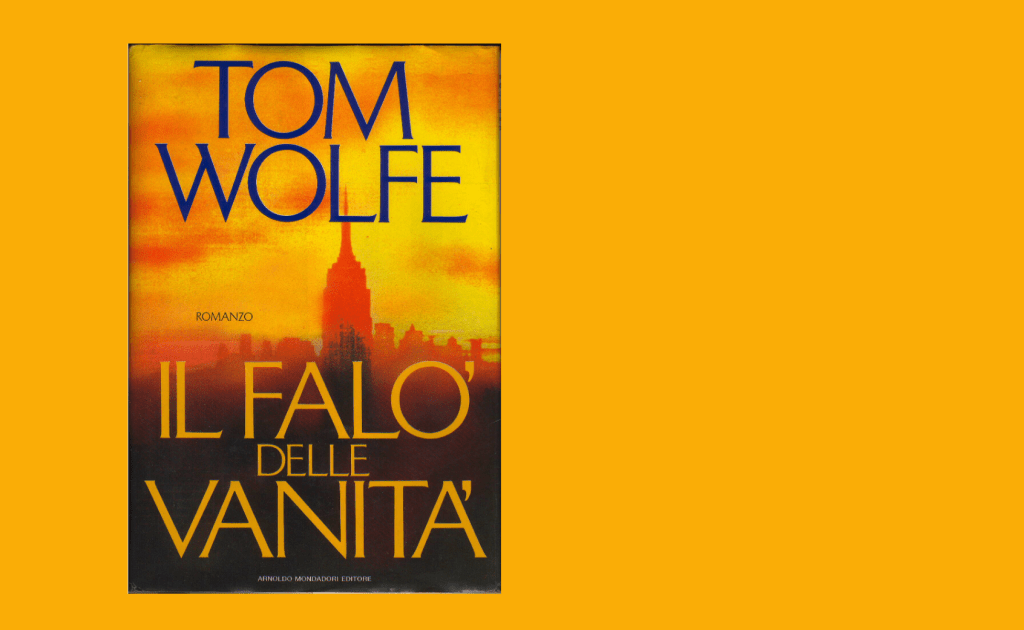
There is one book that more than any other has narrated the vertigo of power during the years when New York was the center of the world: The Bonfire of the Vanities by Tom Wolfe. Published in 1987, the same year Oliver Stone brought Wall Street to the screen , the novel is the chronicle of an America drunk on itself, convinced it had found the formula for eternity, yet already on the verge of collapse. Wolfe doesn’t simply tell a story: he paints a portrait of civilization, a sociological analysis disguised as a novel, in which every daily gesture becomes a symbol of a system on the brink.
These were years when capitalism took on the tone of faith, finance transformed into spectacle, and ambition became the measure of personal worth. New York seemed like a constantly expanding organism, pulsating like an electric heart. Limousines paraded along the avenues, skyscraper elevators ascended ceaselessly, and behind every illuminated window, the same aspiration could be glimpsed: to win, to stand out, to resist time. Wolfe observes all this with the eye of a reporter and the sensitivity of a novelist; he describes the shining surface of the American dream, but also listens to the underlying sound of the crack that runs through it.
The protagonist, Sherman McCoy, is the “Master of the Universe,” the man who owns everything yet no longer owns himself. He lives between Park Avenue and Wall Street, speaks the language of the elite, yet is held hostage by them. When a trivial accident changes his life, every balance collapses, and with it, the facade of an entire society. Wolfe uses his descent as a tool to probe the mechanisms of power that govern metropolitan America: the media system that builds and destroys reputations, the politics that feeds on scandals, the justice system that follows the winds of public opinion.
In his world, success is no longer a goal but a curse, a condition to be defended every day like a territory under siege. It’s the image that must be kept intact, even when everything inside crumbles. Wolfe doesn’t judge his characters: he lets them navigate their labyrinth of luxury and fear, showing them in the tension between the desire to be loved and the terror of disappearing. And it is precisely in that tension that the title’s profound meaning is revealed: the bonfire burns not only riches, but the very vanities that created them.
New York, in those years, was a city with a distinct sound: the buzz of faxes, the crackle of telexes, the dry click of telephones, and the distant echo of horns on Fifth Avenue. It also had a smell: leather, rain, and cigars. Every building seemed a living organism, breathing in time with the stock market. But behind the glittering facade, Wolfe glimpses another city, one hidden in forgotten neighborhoods, where social frustration simmers and injustice becomes daily occurrence. The novel connects these two worlds without ever truly bringing them together: the cocktail party and the riot, the boardroom and the prison, finance and the street. It is in the gap between these universes that Sherman’s tragedy unfolds, and with him, that of an entire era.
Wolfe’s writing is visionary and relentless. With the precision of an anthropologist, he captures the linguistic quirks, fashions, and rituals of the New York elite, turning them into a moral sculpture. Every word carries the weight of an investigation; every scene is an X-ray of power. But beneath the satire emerges an elegiac, almost compassionate tone: the author knows that that era, with all its excesses, also represented the last form of authentic vitality before the dematerialization of the economic world.
Because today that power no longer has a face, a voice, or a scent. It’s not measured in square meters or dollars, but in attention, visibility, and data. In the 1980s, power inhabited real rooms, smelled of polished wood and whiskey, and spoke in closed-door meetings; today it lives within algorithms that decide who counts and who disappears. What was once personal vanity has transformed into collective, shared vanity, quantified in numbers and graphs. And while Wolfe’s men desperately tried to defend their public image, we defend our digital presence, which is the same thing, only more subtle.
The Bonfire of the Vanities remains a prophetic novel. It speaks of an America that believed it owned the world and ended up being possessed by its own reflection, but it also speaks of us, of the way we continue to confuse success with meaning. It is a book that never ages, because it describes an eternal mechanism: the ego that builds empires and destroys them, the vanity that turns on the light and then consumes it. That world will never return, not because the money has run out, but because its grammar has changed.
Then it had a sound, a smell, a room. Today it is silent, invisible, yet omnipresent. Power has become transparent, and precisely for this reason impossible to grasp.
–
–
Alessandro Sicuro
Brand Strategist | Photographer | Art Director | Project Manager
Alessandro Sicuro Comunication


 Sure-com America