
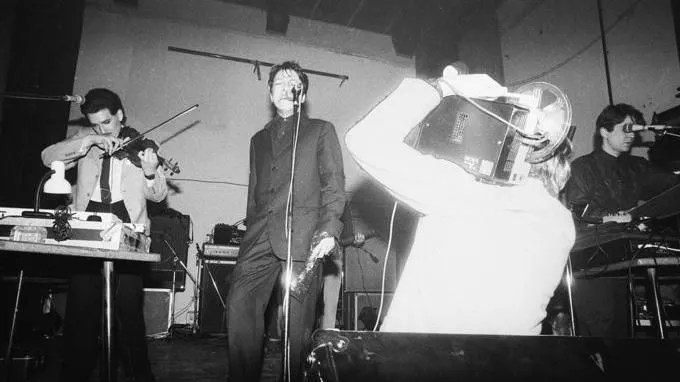
For those who live by communications, art, visuals, photography, and culture, Tenax has never been “just a place to dance.” It was a magnetic field: an open laboratory where images became vibrations and rhythm held together a community hungry for new languages. “Disco” sounds narrow: there, music didn’t decorate, it transformed. For those who breathed it as a kid, it meant participating in a true cultural renaissance.

It was founded in September 1981, driven by the winds of new wave, dark music, and punk from the United Kingdom. In Florence, in a changing Italy, three young entrepreneurs lit the fuse: Roberto Nistri (publisher of Controradio), Sandro Coragli, and Lando Di Bari. Tenax was born innovative and alternative, attentive to new styles and the collision of worlds; and the “contrarian” DNA of Controradio—founded in 1975 and a pioneer in giving space to youth culture and unconventional sounds—is reflected in the programming and the energy of the audience. Nistri’s artistic output within the Controradio ecosystem was instrumental in defining the club’s identity and scouting.

From there, the scene sheds its skin without losing its soul. From the nights that rewrote the European imagination to the rise of DJ-producers who transformed the decks into a research tool, Tenax becomes a cultural institution of the night. Actors, writers, singers, and men and women of culture take turns within those walls; lights, sound, bodies, and gazes compose, each time, a total aesthetic. The club’s chronology charts the transition well: from post-punk/new wave fervor to openness to new generations, up to the centrality of the DJ set in the most recent season.

A Hall of Fame as long as an atlas explains why “disco” is reductive. Without listing it all: the epic new wave era (New Order, Bauhaus, Sisters of Mercy, Tears for Fears, Human League), the pop-culture and alternative trajectory (Radiohead, Procol Harum, Frankie Goes to Hollywood, The Jesus and Mary Chain, The Stranglers), and, when the night becomes an electronic laboratory, seminal acts (Daft Punk, Basement Jaxx, Kruder & Dorfmeister, Thievery Corporation), all the way to the club culture greats and the era-defining resident acts. Not a lineup: a map of the contemporary.

In the mid- 1990s , the relaunch expanded its lineup and reaffirmed a qualitative approach that integrated live and international club culture. The difference—then as now—lies in the continuity of the scene: not a disposable event, but an ecosystem that endures and evolves. This is also why Tenax continues to live on in the global imagination of institutional clubs.
–
–
Alessandro Sicuro
Brand Strategist | Photographer | Art Director | Project Manager
Alessandro Sicuro Comunication


 Sure-com America