
–
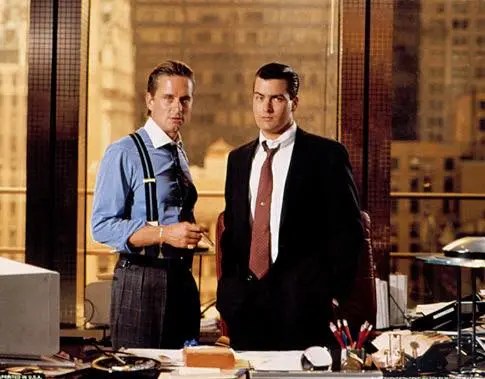
There’s one film that more than any other captures the heights of unscrupulous finance and the greed of capitalism: Oliver Stone’s Wall Street . Released in 1987, the same year as Tom Wolfe’s The Bonfire of the Vanities , it seems like a natural sequel. If Wolfe had exposed the vanity of New York’s elite, Stone exposes its hidden driving force: greed. Two works, one literary and one cinematic, born from the same cultural magma: 1980s New York, a vertical city where money becomes religion and power a form of mystical experience.
Stone co-wrote the screenplay with Stanley Weiser, and he’s no ordinary director. His father, Lou Stone, had been a real Wall Street broker. Oliver had breathed that electric, tense atmosphere, saturated with ambition and cynicism, since he was young; he knew the tics, the silences, the early-morning and late-night phone calls, the meetings behind closed doors, the cold toasts, the pats on the back that smell of convenience. Wall Street wasn’t born as a stylistic exercise, but as a confession: it’s an inside story, filtered by cinema but rooted in real life.
The character of Gordon Gekko, masterfully played by Michael Douglas, epitomizes this vision. He embodies the predatory philosophy that transforms greed into virtue, deception into method, ruthlessness into competence. His speech at the Teldar Carta assembly is the ideological heart of the film. Gekko doesn’t limit himself to slogans: he explains that he spent months analyzing balance sheets, cash flows, and expense reports, and that x-ray paints a pitiless picture. A bloated, self-referential corporate bureaucracy, populated by executives no one could truly describe: dozens of vice presidents stamping papers, producing memos, moving files from one desk to another, while millions of dollars dissolve into “consulting,” benefits, travel, hunting, golf, lunches, and golden severance packages. It’s a snapshot of managed capitalism that has lost touch with real production and continues to reward those who risk nothing, shielded by luxurious contracts and nebulous responsibilities.
In that passage, Gekko appears almost like a vigilante, exposing a system more corrupt than his own raids. And it’s here that the film becomes subtle: his critique of the paralyzed corporation is credible precisely because it sinks its teeth into historical truth. Gekko is evil speaking a part of the truth about the rotten respectability. When he utters his “Greed is good. Greed is right. Greed works,” he’s rallying the support of an audience that knows deep down they’re the problem but prefers to applaud those who absolve it by transforming vice into doctrine. It’s the moment Stone shows how America, which fancies itself a global moral power, has chosen to equate efficiency with ferocity, meritocracy with a license to devour everything.
From then on, every one of Gekko’s lines becomes a fragment of a manifesto: “Money never sleeps,” “Information is the most valuable commodity,” “No one gets rich working for someone else.” These aren’t just cinematic punchlines: they’re the catechism of a capitalism that has decided to correct its public face, not its foundations. The jungle Gekko invokes isn’t a metaphor: it’s the new natural order, where only those who bite first survive.
Stone knows that jungle and describes it without compromise. He doesn’t moralize or simplify; he forces the viewer to confront the predator’s allure. When Gekko drags Bud Fox—the young broker played by Charlie Sheen—across the border, inviting him to seek inside information, to exploit his relationship with his father, to violate trust to anticipate the market, the ascent merges with moral contamination. The climb to power coincides with the loss of self. The film doesn’t simply denounce illegality: it shows how the system itself rewards those who learn to skillfully confuse opportunity and abuse, talent and oppression, strategy and betrayal.
Through Bud’s eyes, Wall Street becomes the story of an end: the end of innocence and the meritocratic fairytale. The arc is clear: from the enthusiasm of those who want to “make it” to the disillusionment of those who discover the human cost of success. The glittering New York of skyscrapers, lofts, and panoramic restaurants coexists with his father’s factory, with those who truly work, with those who risk their jobs while the spoils are shared at the top. Every gain for Gekko corresponds to an invisible loss for someone. Every winning trade brings with it layoffs, shattered lives, communities erased from the balance sheet.
Today, the landscape has changed, but the mental structure remains the same. Greed no longer requires cigars, suspenders, and landlines: it disguises itself as an algorithm, a global fund, a technical acronym that decides mergers, cuts, and capital movements that no one outside the room truly understands. If in the 1980s, Stone could still show us the faces of power, today much of that power is opaque, automated, distributed across financial structures that operate without a visible body. But the underlying philosophy remains the same: privatize advantage, socialize risk, transform excess into normality.
The difference is that the price isn’t measured solely in dollars. Also burned in the contemporary bonfire are time, attention, quality of life, and collective trust. Finance has become an operating system that infiltrates everyday choices: what we buy, what we desire, the cities we live in, the jobs we accept, the fear of losing everything. In this context, Wall Street continues to speak to the present, not as a relic of the 1980s, but as an x-ray of a mechanism that has merely changed its interface.
This is why Oliver Stone’s film remains one of the most lucid parables of our time. It’s not just a tale of finance, but a meditation on identity, on ethics, on the exact point at which success ceases to be conquest and becomes surrender. It reminds us that when greed is elevated to a foundational value, everything else—dignity, responsibility, community—is relegated to marginal cost. The bonfire of greed has never been extinguished: it has simply learned to burn silently, behind glowing screens and quarterly reports. And it continues, stubbornly, to illuminate the part of us willing to believe that winning justifies any cost.
Disclaimer: This post is for cultural dissemination purposes. Content is for journalistic and educational purposes only; it is not sponsored or intended to promote financial products or services.
–
–
Alessandro Sicuro
Brand Strategist | Photographer | Art Director | Project Manager
Alessandro Sicuro Comunication


 Sure-com America