

House music was born in Chicago in the early 1980s, in a rough, working-class city marked by factories and social distancing. It was born in basements and recycled warehouses, in venues where Black, queer, and working-class communities sought freedom in an America that ignored or judged them during the day. Night was the only negotiable space, and there, music wasn’t there to entertain: it was there to survive, to breathe, to exist.

Ron Hardy: The Crazy DJ Who Conquered Chicago in the Early ’80s
The heart begins to beat in a place that is now legendary: The Warehouse, a converted warehouse at 206 South Jefferson Street, a private club. When the owners called Frankie Knuckles from New York in 1977, they didn’t know they were handing over the future to a room full of speakers and souls seeking space. Frankie took the legacy of disco—soul, gospel, funk—and reshaped it, stretching tracks, manipulating tapes and reels, creating never-ending emotional waves. In that semi-darkness, the dance floor doesn’t dance: it heals, liberates, rediscovers its identity. People who had no place outside—Black, Latino, queer, kids without social protection—found a home there. And indeed, it was precisely by asking stores for “the music they play at the Warehouse” that the spontaneous label was born: house music. The name comes from the people, not from marketing.
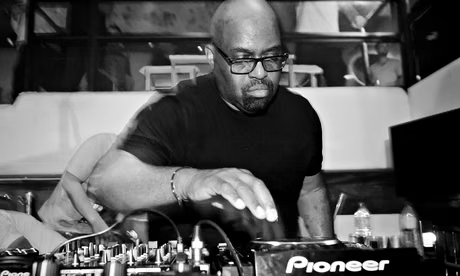
Frankie Knuckles is an American DJ and record producer, known as “the Godfather of house music”
When Frankie leaves to open the Power Plant, the Warehouse transforms into the Music Box, and Ron Hardy, his dark twin, enters the scene. If Knuckles was elegance, Hardy is fever. He plays at insane volumes, rips, accelerates, breaks down, reassembles. He uses Roland drum machines—808s, 909s—as if they were rhythmic dynamite.
If Frankie constructs the liturgy, Hardy sets the altar ablaze. The dancefloor enters a trance, the music becomes physical, urgent, almost primal. Perfection isn’t what’s sought: the jolt is sought.
Chicago doesn’t offer glamour, it offers truth. It offers concrete, sweat, distorted signals, makeshift systems. And precisely there, where everything else is missing, everything is born. Between clandestine tapes, private evenings, and a new generation of producers like Marshall Jefferson, Larry Heard, Jamie Principle, Phuture, house takes shape as an urban and liberating language, where repetition doesn’t bore but liberates, and the beat doesn’t entertain but affirms: I’m here, I’m worth it, I breathe.
It’s no coincidence that music spread from Chicago to the world. Those who left those clubs saw something that couldn’t be explained, only followed. House isn’t a genre: it’s a collective awareness in 4/4. A humble technology that becomes soul, a sweaty dance floor that becomes community, a wounded city that, for the first time, taught the world that dancing isn’t about escaping: it’s about returning to oneself.
From that industrial and rebellious night, everything began to change. And from that stubborn beat, a revolution began that has never stopped.
–
–
Alessandro Sicuro
Brand Strategist | Photographer | Art Director | Project Manager
Alessandro Sicuro Comunication


 Sure-com America