
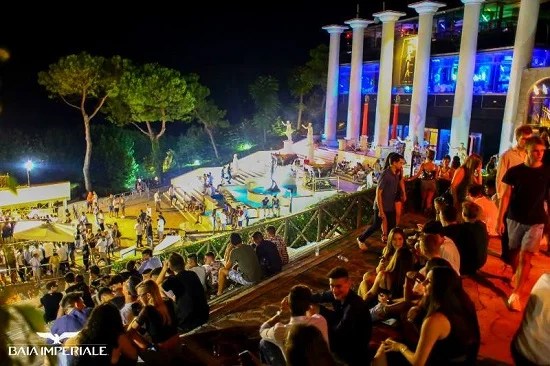
From that blend, a new language was born—cosmic sound—and with it the first true identity of Italian clubbing, one of sonic exploration and mental freedom. La Baia wasn’t a nightclub. It was a visionary portal, a lucid journey into the night. The music didn’t serve to fill the silence, but to transcend reality, to make bodies vibrate like antennas of the same energy. Those who entered didn’t come to dance: they entered into a trance. When La Baia closed its doors in the late 1970s, its legend was already myth.
It is said that on the last night, everyone could take home a piece of furniture, like a relic of a dream. And a few years later, in 1983, that same place was reborn under a new name and a new form: Baia Imperiale. Same cliff, same sea, but another era—more monumental, scenic, Roman. A legacy, not a copy. Many years later, while the world idolizes Studio 54, Ibiza, and Chicago house, few will remember that it all—for us—began here: on a cliff overlooking the Adriatic, where a visionary had lit the first light of modern clubbing.
Today, that myth still resonates in electronic festivals, ambient sets, and underground clubs that seek not only to make you dance, but to take you on a journey. The Bay of Angels isn’t a memory: it’s an ancient frequency, a vibration that continues to resonate in those who believe that music is a form of collective upliftment. Deep Groove Diary is a dive into those roots. Because to understand today’s music, we must return to where rhythm learned to dream.
–
–
Alessandro Sicuro
Brand Strategist | Photographer | Art Director | Project Manager
Alessandro Sicuro Comunication


 Sure-com America