
3I-ATLAS
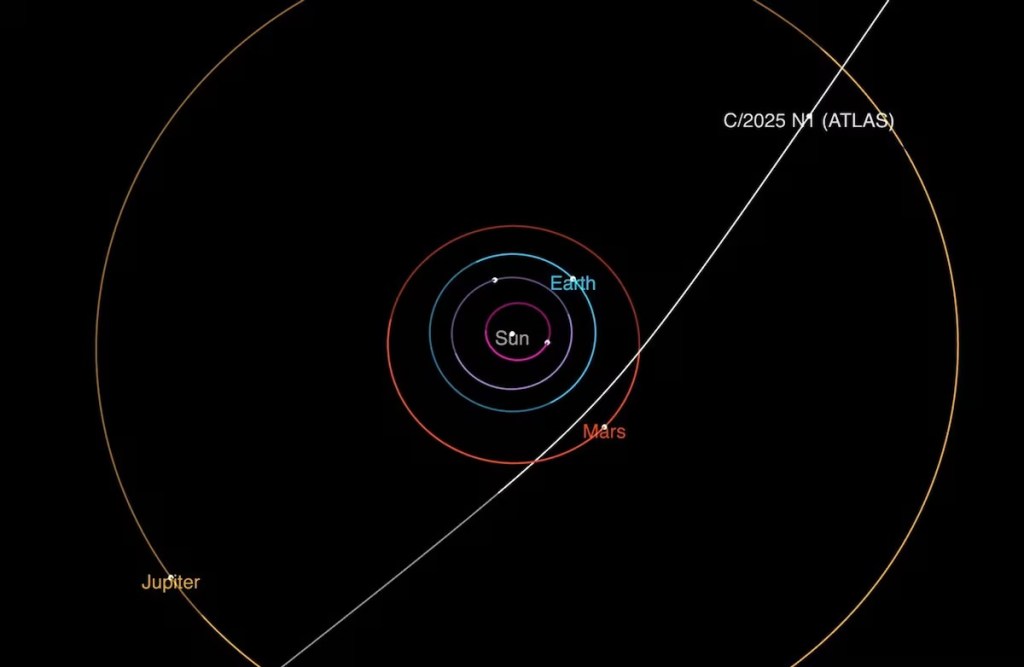
There’s been a lot of talk these days about the object called 3I/ATLAS, which isn’t just “another comet,” but a traveler from outside our Solar System. It’s the third confirmed interstellar object in the history of modern astronomy, after ʻOumuamua (2017) and Borisov (2019). (NASA Science)
Origin and orbit
The object was discovered on July 1, 2025, by the ATLAS surveillance system, installed at the Cerro Tololo Observatory in Chile. (NASA Science – Planetary Defense). Its orbit is hyperbolic, a characteristic that distinguishes it from all “local” comets and asteroids: this means that it is not gravitationally bound to the Sun, but comes from beyond the edges of the Solar System and, after passing by, will continue its course into the unknown. ( Space.com )
Perihelion—the closest point to the Sun—is expected on October 30, 2025, at about 1.4 astronomical units (slightly more than the Earth-Sun distance). It poses no threat to our planet, but offers a unique observation opportunity. (NASA)
Composition and activities
The most recent observations, made by the Gemini South telescope and confirmed by NOIR-Lab, show that 3I/ATLAS has an active coma and a faint tail: a sign that the nucleus, composed largely of ice and organic material, is sublimating in contact with solar radiation. (NOIR-Lab News Release)
According to the spectroscopic data collected, the comet has an unusually high amount of carbon dioxide relative to water. This anomaly suggests that 3I/ATLAS was intensely heated or irradiated before being ejected from its parent system, making it a valuable sample of interstellar chemistry. ( Space.com )
The size of the nucleus remains uncertain: estimates range around 5–6 kilometers in diameter, but the variability of the coma makes a precise measurement difficult. (NASA Hubble)
Curious aspects and conjectures
Some astrophysicists speculate that 3I/ATLAS may be older than the Sun, and therefore carry materials formed in the early stages of the Milky Way. ( Space.com )
Some have noted unusual behavior: slight accelerations, variations in brightness, and a surprisingly stable trajectory, elements that have sparked fantasies and online discussions. (The Guardian) And, as often happens, there is no shortage of more extreme theories: a recent article on Live Science reported the speculative hypotheses of some researchers who have compared the behavior of 3I/ATLAS to that of an artificially controlled object, although the scientific community considers this hypothesis baseless. (Live Science)
Conclusion
Through data, images, and insights, 3I/ATLAS reminds us how little we still know about our galactic neighborhood. A fragment of matter from another star, a traveler crossing our sky, leaving more questions than answers.
And it is precisely there, in the mystery measured by science, that humanity rediscovers its ancient gaze: the one that has always scrutinized the sky, wondering who else, out there, might do the same.
–
–
Alessandro Sicuro
Brand Strategist | Photographer | Art Director | Project Manager
Alessandro Sicuro Comunication


–
–
–
 Sure-com America