
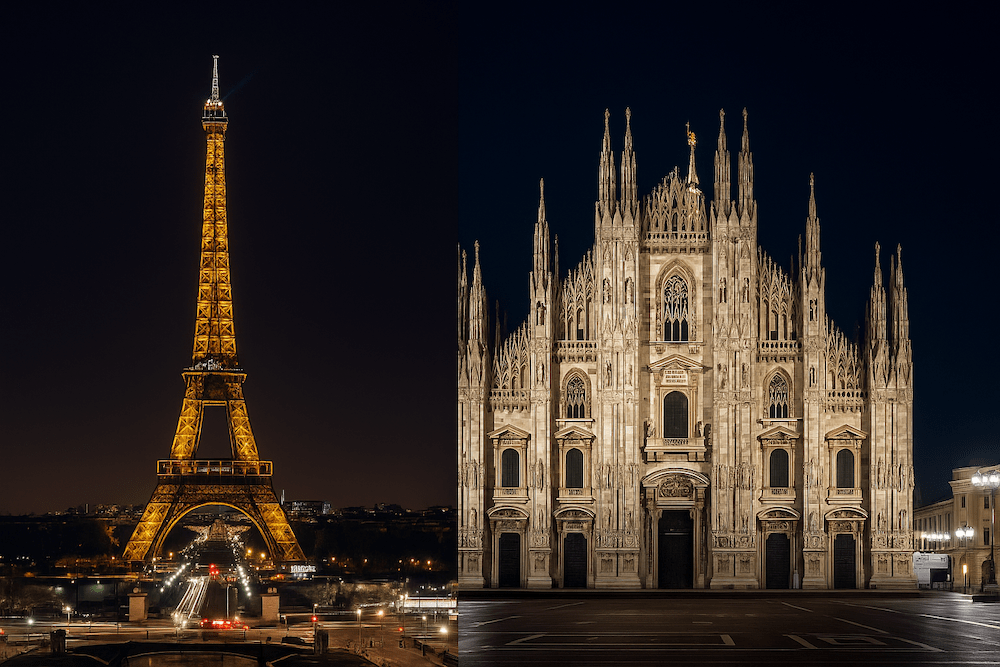
MILAN vs PARIS, THE FASHION CAPITALS
Same month, two capitals. In Milan and Paris, fashion takes center stage, but the figures tell two different stories: on the one hand, the urban induced industry and manufacturing boom; on the other, the billion-dollar weight of global orders.
In Paris, the Fédération de la Haute Couture et de la Mode orchestrates six official events a year: two weeks dedicated to women’s fashion, two to men’s fashion, and two to haute couture. It’s a tight schedule, punctuated by six media and commercial peaks every twelve months. Last season, there were over seventy shows for women’s ready-to-wear alone. It’s no coincidence: Paris doesn’t just sell clothes, it sells the very idea of centrality. And the numbers confirm this primacy. According to the Institut Français de la Mode, French fashion weeks generate approximately ten billion euros in orders annually. We’re not talking about tourism or full hotels, but designer collections, open showrooms, and international buyers who transform the catwalks into tangible business.
Milan responds with a robust calendar: two weeks dedicated to women and two weeks dedicated to men. The latest edition, in September 2025, featured more than 170 events, including fashion shows, presentations, and events. Here, the metrics are different: the National Chamber of Italian Fashion estimates the city’s revenues at approximately €239 million in a single week, and over €423 million for the entire year, combining February and September. These figures demonstrate the city’s attractiveness, the immediate impact on the local economy, but also the vitality of an industrial fabric that remains the beating heart of global manufacturing.
And this is where the comparison becomes interesting. Paris signs contracts, increases exposure, and fuels business with a never-ending communications machine. Italy, on the other hand, has a silent but powerful engine: know-how. A knowledge built up over centuries, a widespread production network, sometimes artisanal, sometimes almost guerrilla, which has made our country a leader in textiles and clothing. But in reality, we don’t exploit this heritage enough. We don’t defend it with the same vigor with which the French protect and promote their products.
And here begins a reflection that goes beyond fashion. The same applies to food and beverage, design, and art: Italy, thanks to its geographical position, climate, and biodiversity, is a natural laboratory of excellence. The basil of Pra, the wine of Gragnano, the olive oil of the Florentine hills, the Prosecco of Veneto, the licorice of Calabria: all arise from unique conditions, unique in the world. Yet, too often, we fail to protect these treasures with the same strategic clarity as our neighbors.
This isn’t a polemic, it’s an open question: why does a country with 70% of the world’s artistic heritage and a recognized leadership in food and wine and manufacturing continue to play defense rather than offense? Perhaps the answer lies right here: recognizing our weaknesses is the first step to doing better. Milan and Paris remind us that numbers matter, but what will truly make the difference, in the long run, will be the ability to transform know-how into a system.
Alessandro Sicuro
Brand Strategist | Photographer | Art Director | Project Manager
Alessandro Sicuro Comunication


 Sure-com America