
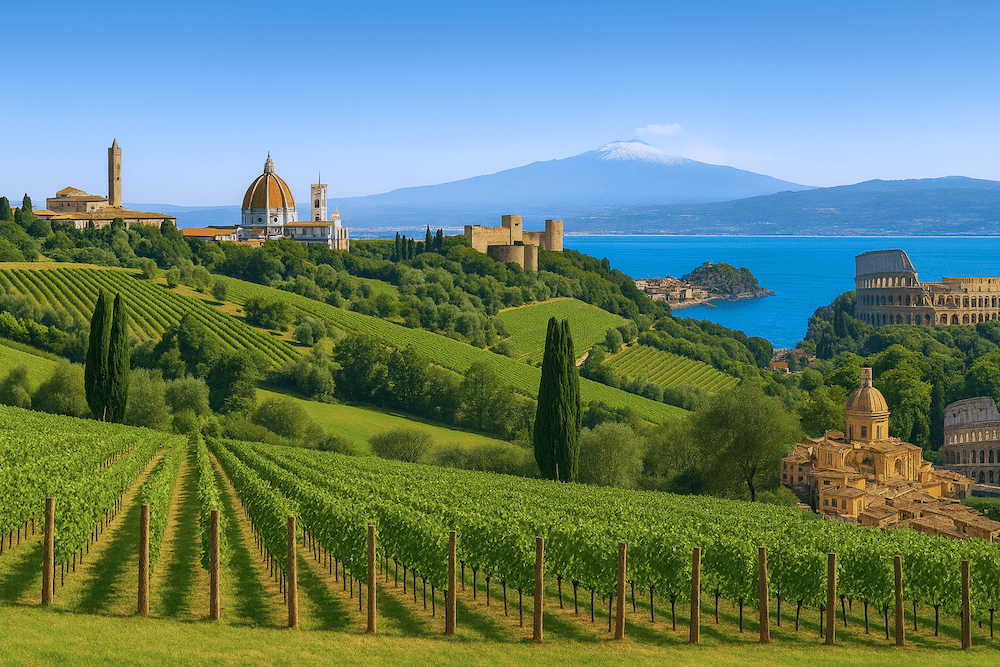
ITALY, A UNIVERSE OF EXCELLENCE
Italy occupies just 0.50% of the Earth’s surface and is home to 0.83% of the world’s population. These seemingly insignificant numbers, yet within these borders lies a wealth unmatched by any other country: natural, cultural, and artistic biodiversity.
Our peninsula stretches along the Mediterranean, a “good” sea that for millennia has united rather than separated. Here, sea winds meet fresh mountain air and hillside breezes, creating unique microclimates. It is in these unique conditions that historic products are born: Pra basil, San Daniele prosciutto, Gragnano pasta dried in the famous “wind tunnel” between Vesuvius and Castellammare. Abruzzo saffron, Calabrian licorice, Sardinian myrtle, Pachino tomatoes, olive oil from the hills of Reggello and Fiesole, and Prosecco from the Veneto hills. Each region holds a treasure that intertwines wind, water, and earth.
The numbers, certified by international organizations, speak volumes about this exceptional situation. According to the FAO, over 7,000 edible plant species grow in Italy: Brazil, second in the world, has less than half that number. ISPRA documents the presence of approximately 58,000 animal species, a European record. Italy also boasts over 1,200 native grape varieties (compared to 222 in France), 533 olive varieties (Spain has only 70), and 140 durum wheat cultivars (the United States has just 6). This biodiversity is not just theory, but daily practice, and it translates into landscapes, typical products, and gastronomic culture.
But Italian excellence doesn’t stop at nature. It also encompasses design, fashion, and art. These days, Milan is turning the spotlight on Fashion Week, a globally renowned event that, along with Pitti Uomo in Florence, represents the heart of men’s style. Rome, with its intertwining history and contemporary creativity, completes the mosaic. Italian design is more than just a catwalk, but a global language that continues to dictate trends.
Then there’s the literature that spawned Dante and Calvino, the music of Verdi and Morricone, the cinema of Fellini and Antonioni. There’s the scientific research and medical breakthroughs that bear Italian signatures. There are the landscapes sculpted by farmers, who have designed hills, vineyards, and fields, transforming them into universal postcards. It’s no coincidence that UNESCO certifies that Italy is the country with the highest number of World Heritage Sites in the world, confirming that famous “70% of the planet’s beauty is concentrated in 0.50% of its territory.”
Yet this wealth isn’t just a privilege to be admired: it’s a responsibility to be passed on. It should be taught starting in elementary school, to help children understand that Italy isn’t just a place they live in, but a unique heritage to be protected. Knowing that the most fragrant basil, the most celebrated wine, the most beloved art originate here shouldn’t translate into arrogance, but rather into pride and concern.
No one chooses the place of their birth. But being born in Italy means belonging to a tiny fragment of the world that holds an entire universe. It’s a gift, but also a responsibility: to ensure that this heritage continues to live, grow, and evolve. Because the fortune of being born here must be earned every day.
Alessandro Sicuro
Brand Strategist | Photographer | Art Director | Project Manager
Alessandro Sicuro Comunication


 Sure-com America