
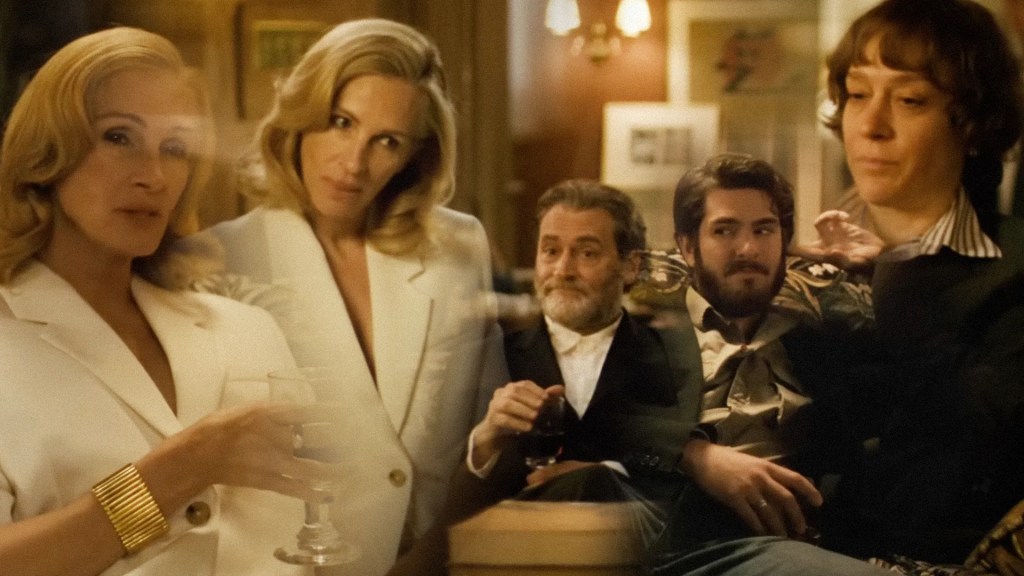
AFTER THE HUNT IN VENICE 82
Luca Guadagnino’s new film, After the Hunt, is presented out of competition. This is no coincidence: the Palermo-born director, always interested in exploring the boundaries between desire and power, this time brings the tension to the halls of an Ivy League university, transforming them into a moral arena.
At the center is Julia Roberts , a cinema icon who embodied romantic lightness in the 1990s, and who now finds herself playing Professor Alma Olsson, caught between her career, ethical responsibilities, and a resurfacing past. Her decision to defend a colleague accused of harassment ushers the plot into tricky territory, where defending her reputation becomes a pretext to reveal her own dark sides. Alongside her, a wide-ranging cast—from Andrew Garfield to Ayo Edebiri, from Michael Stuhlbarg to Chloë Sevigny—builds a mosaic of fragility and hypocrisy.
Guadagnino chooses a psychological thriller tone, where the drama doesn’t explode but rather insinuates itself: every classroom, every corridor in Cambridge becomes a place of suspense. The cinematography, by Malik Hassan Sayeed , is simply stunning: light and shadow are not just a frame but a language, capable of transforming the academic space into a mental landscape, where every gesture is charged with tension and ambiguity. Completing the picture is the magnetic music by Trent Reznor and Atticus Ross , which amplifies the sense of unease.
The film isn’t just an academic narrative: it’s also a political act. In the post-#MeToo era, After the Hunt risks dividing public opinion because it dares to focus on the defense of an accused man, rejecting facile Manicheism. This is a minefield that could prove as powerful as it is controversial.
Yet, behind the narrative, there’s also an industrial game at play: the film is the first Amazon MGM title distributed by Sony Pictures after the end of its agreement with Warner Bros. This move marks a change of direction in the way American cinema, with the Italian contribution of Frenesy Film, is trying to redefine its global distribution.
With its 138 minutes, Guadagnino doesn’t try to please. Instead, he offers a dense, imperfect, perhaps divisive, but necessary film. At Venice Film Festival 82, After the Hunt is out of competition, but not out of the question. Every shot seems to ask the viewer: “What are you willing to defend, and at what cost?”


Alessandro Sicuro
Brand Strategist | Photographer | Art Director | Project Manager
Alessandro Sicuro Comunication


 Sure-com America