
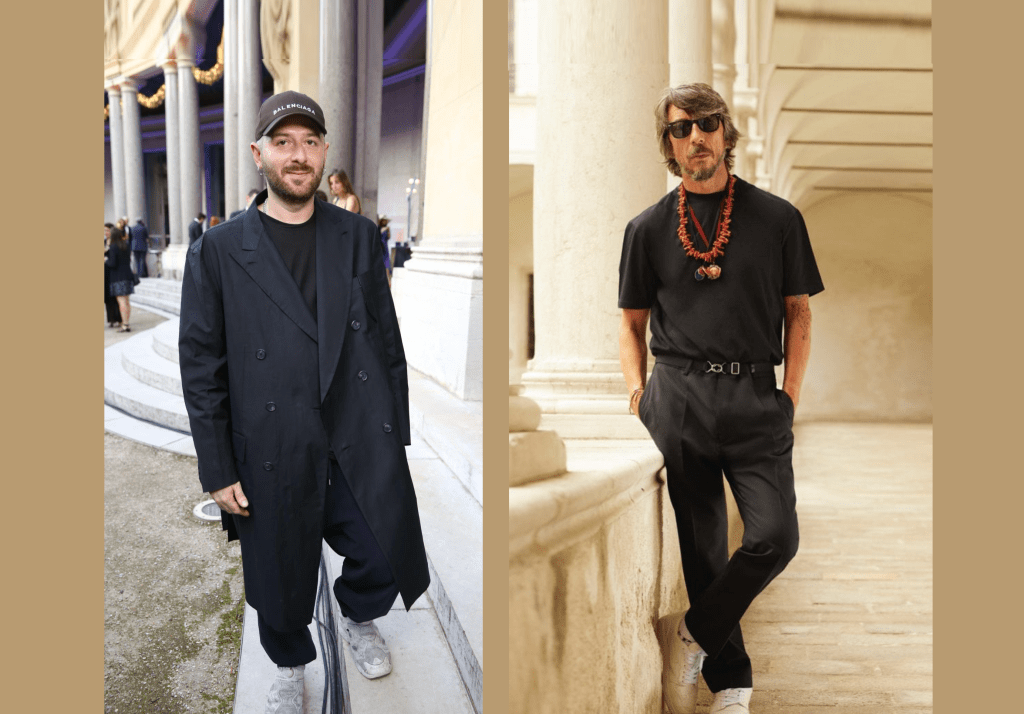
Creative Appointments at Kering
They entrust Pierpaolo Piccioli with the creative direction of Balenciaga. He, refined and measured, is the author of a couture that becomes a human, spiritual narrative. He arrives at a maison that, under the direction of Demna Gvasalia, brought fashion to the edge of traumatic aesthetics, of destructive gesture, of visual provocation elevated to language.
Meanwhile, in a play of reflections that feels almost mythological, Demna himself seems to shift his vision — or at least his legacy — toward Gucci. Two intersecting trajectories. Two restless gods who find themselves in temples not their own, and precisely for this reason, charged with symbolic tension.
Balenciaga – Gucci: Two Genealogies in Contrast
Balenciaga is cut, structure, thought. Fashion as architecture and visual hypothesis.
Gucci, by contrast, is code. Accessories as signs, as history, as status. It’s the bag, the shoe, the detail that speaks of an era.
The horsebit, the Jackie, the Bamboo — these are objects that speak, that carry layered meanings.
And this is where a second, crucial point emerges: younger generations do not truly know this heritage.
Not out of disinterest, but because no one has been able to convey it with depth.
The value of craftsmanship, of a culture of beauty, of invisible precision — this is a kind of knowledge that is fraying. A value that neither politics, nor business, nor education has been able to communicate with due pride.
And yet it is precisely what even the youngest consumers often seek — unknowingly — in the clothes and objects they choose to wear.
But how many truly understand the technical and symbolic meaning of a well-made loafer?
How many know the difference between a salpa heel counter and a plastic one, or between a water-based natural glue and an industrial chemical adhesive?
Or that a quality shoe must rest for at least five days on the last, to ensure structure and durability?
In Italian excellence — Ferragamo, for instance — these rituals endure.
And while young artisans from all over the world — particularly from Asia — come to Italy to learn these techniques, here at home they risk being pushed to the margins.
This is not a reproach. It is an observation: we live in a time when know-how has become invisible, and the system often lacks the tools to recognize, appreciate, and elevate it.
Inside a “manovia”: Where Fashion Is Real
You only need to step into a manovia — those departments where shoes and bags are crafted for major brands — to understand.
You just need to breathe: the scent of freshly cut leather, raw, alive. The understated beauty of accessories: every stitch is a choice, every shape a language. The wisdom of hands: the master shoemaker, the leather cutter, the pre-mounter.
Hands I have seen at work in the shoe and bag factories of Italy’s most important brands. The knowledgeable, precise, invisible gesture. That is the gesture that makes fashion real.
Piccioli and Gvasalia: Two Opposing Forces, One Cultural Challenge
Perhaps we were dreaming of a return — Tom Ford at Gucci, or at least a glamorous, sensual, cinematic echo.
Like the “Cruise 2026” show in Florence: a return to codes, a celebration of the archives, a rigorous iconographic approach. But no…
Kering chose risk, dissonance, confrontation.
Piccioli lands at Balenciaga to rebuild, with grace and precision, a new language within a desacralized temple.
Demna, with his deconstructive charge, may bring to Gucci another jolt — certainly another terrain of visual conflict.
And so we ask: which legacy will truly be heard?
Who will speak to the deeper desires of the public — not just to its superficial reactions?
And more than anything, who will have the courage to restore value to the content, not just the message?
Perhaps this is the beginning of a new grammar.
Or perhaps it is only the latest act in a theatre where the restless gods of fashion keep changing temples — but never stop telling us, for better or worse, who we are and where we are going.
Alessandro Sicuro
Brand Strategist | Photographer | Art Director | Project Manager
Alessandro Sicuro Comunication


 Sure-com America