
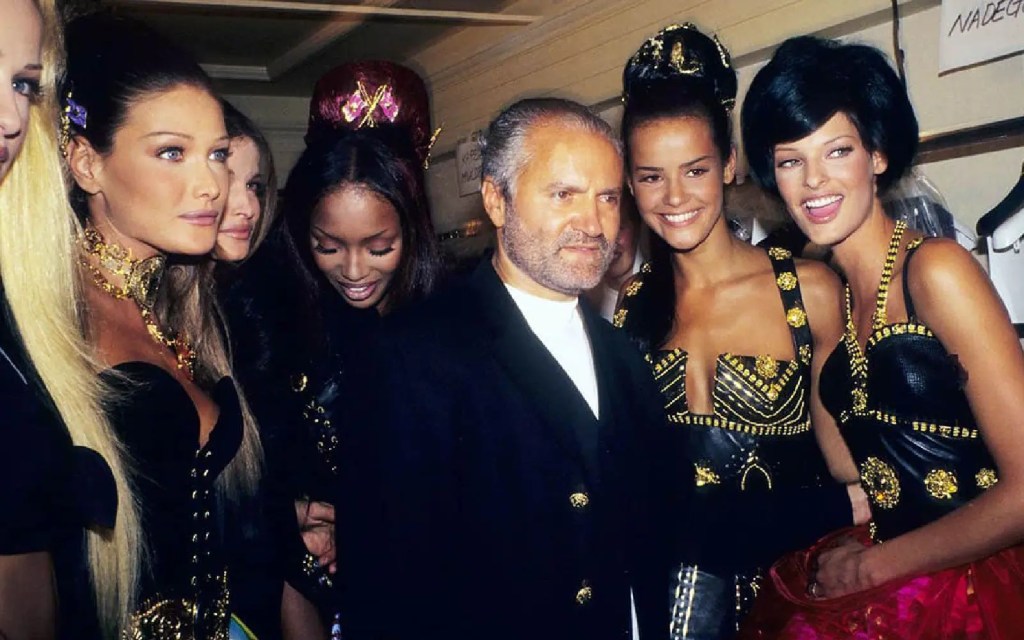
Analyzing the issue of the sale of Versace to the PRADA group, it appears clear how a strongly identifiable brand, born from the creativity of a style icon like Gianni Versace, has managed to maintain its own audience and its own market, despite the evolution of aesthetic concepts over time, even if lately it was starting to show signs of stylistic saturation.
The distinctive codes of his DNA are now considered part of history. The tragic event: on July 15, 1997, not only a man passed away, but a legend of global creative culture. Like a Greek myth, the man died to give life to an immortal myth: Dionysian, avant-garde, unscrupulous and endowed with enormous aesthetic strength, a cultural heritage that in my opinion is typically Italian.
25 years after the murder of Gianni Versace and 6 years after the sale of the fashion house in 2018, the Versace family sold the brand to the investment fund Blackstone for approximately 1.83 billion euros. Subsequently, Blackstone sold Versace to Capri Holdings, the American group that today controls the brand.
There is currently a new deal being discussed: Capri Holdings is negotiating with PRADA to sell Versace for a minimum price of $1.5 billion. Agencies report that, since Prada’s interest emerged – albeit unofficially – new details about the negotiations are coming out every day. In particular, Lorenzo Bertelli, son of Miuccia Prada and Patrizio Bertelli, believed to be the main supporter of the operation, is trying to obtain a reduction in the initial price, while some rumors speak of a four-week exclusivity to conduct the negotiations, although the timing may not be so constrained.
The acquisition is strategic for the Italian group, which intends to strengthen itself in the luxury segment and sees Versace as a brand with great potential, despite recent difficulties: between October and December 2024, the brand recorded a 15% drop in sales, with revenues stuck at 193 million dollars and an operating loss of 21 million. These data could dampen the enthusiasm of Prada and other potential buyers, complicating the achievement of the price hoped for by Capri Holdings.
In case the negotiations with Prada do not come to fruition, Capri Holdings already has a relaunch plan in mind for the brand, which could include – according to some rumors – the exit of Donatella Versace and the entry of a new creative director, such as Dario Vitale, former head of Miu Miu.
In conclusion, my ‘hope’ is that Versace remains in Italian hands, relying on a farsighted and competent CEO, capable of guiding the brand with vision – for example, figures like Marco Bizzarri or Pietro Beccari – supported by an adequate creative team in keeping with the brand’s DNA. It would also be exemplary if the new CEO and creative director had the courage to make bold and visionary decisions, on a par with what was demonstrated by Marco Bizzarri, who hired Alessandro Michele for Gucci, and the vision of Domenico De Sole, who together with Maurizio Gucci hired Tom Ford in 1990. The key to success lies in knowing how to make strategic decisions with courage and foresight.


 Sure-com America